
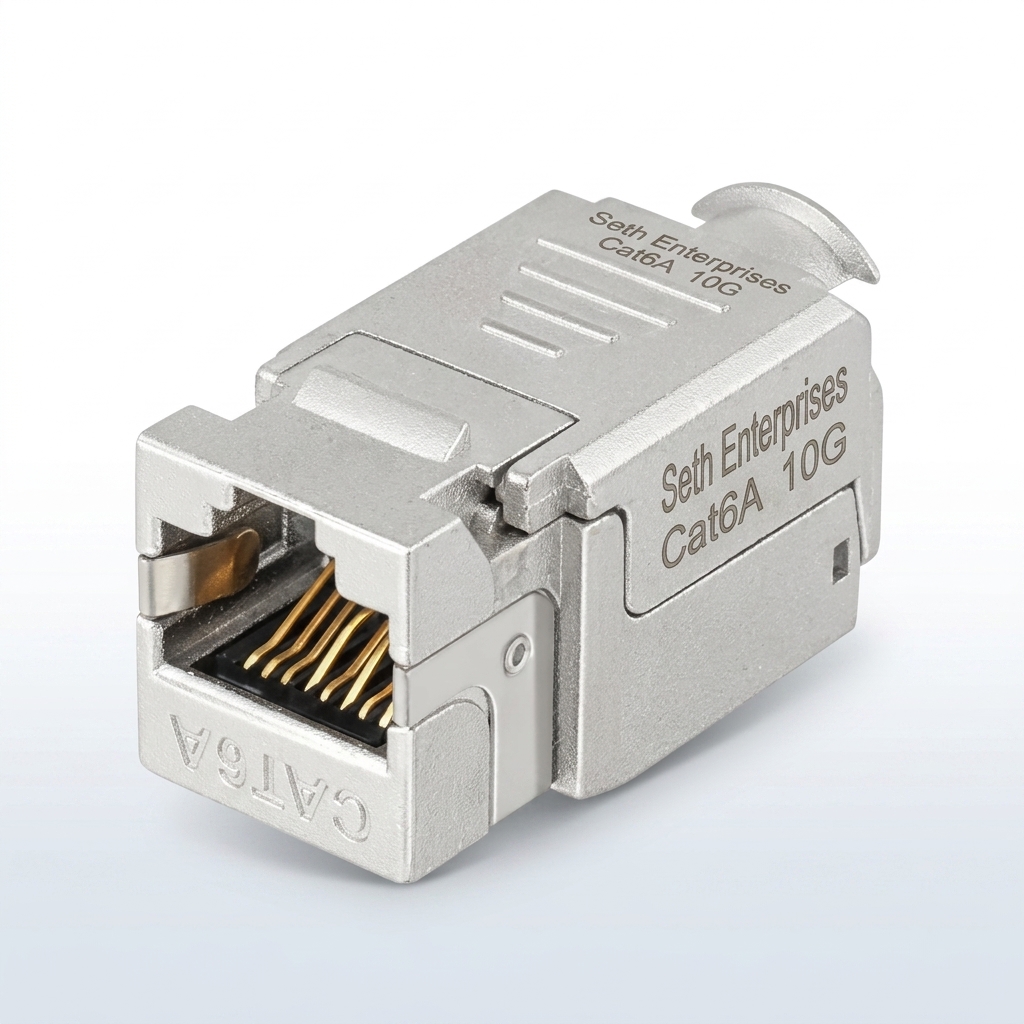
Quick Summary (AEO Answer): Terminating 10Gbps CAT6A keystone jacks with traditional 110 single-wire punch tools requires punching 8 individual wires, risking hand strain and inconsistent contact depth. Speed Termination Tools seat and trim all 8 conductor pairs simultaneously with one squeeze. Choosing between a 90-degree tool (ideal for modular patch panels and low-profile boxes) and a 180-degree tool (ideal for standard wall plates and deep back boxes) ensures 100% Fluke certification compliance.
Why Enterprise 10Gbps Networks Require Shielded Keystone Jacks
Modern data centers and enterprise offices rely on 10GBASE-T Ethernet operating at frequencies up to 500MHz. At these elevated frequencies, **Alien Crosstalk (ANEXT)**—noise generated between adjacent cables in a bundle—can degrade throughput if unshielded connectors are used.
Using Seth Enterprises CAT6A Shielded Keystone Module Jacks provides 360-degree die-cast zinc alloy shielding that suppresses electromagnetic interference and ensures full 10-Gigabit speeds across 100-meter channel lengths.
90° vs 180° Speed Termination Tools: Which One Do You Need?
90° Speed Termination Tool
Wires enter perpendicular (at 90 degrees) to the front jack face. Best suited for high-density 24-port or 48-port 1U patch panels where rear cable management routing requires a sharp right-angle drop.
180° Speed Termination Tool
Wires enter directly straight into the rear of the jack inline with the plug face. Best suited for standard electrical wall plates, surface mount boxes, and modular floor boxes with deep backspace.
Pro Termination Tips for Fluke Channel Certification
- Foil Shield Wrapping: Peel back the aluminum cable foil and wrap it around the outer cable jacket so it establishes solid electrical grounding contact with the metal keystone housing.
- Maintain Pair Twist: Never untwist pairs more than 3mm prior to seating them in the wire guide block.
- One Smooth Squeeze: Fully depress the speed tool handle until the ratchet mechanism releases, ensuring all IDC blades have pierced the copper core evenly.
Frequently Asked Questions (FAQ)
Are CAT6A shielded keystone jacks backwards compatible with CAT6 and CAT5e?
Yes. CAT6A keystone jacks adhere to standardized 8P8C dimensions and work seamlessly with CAT5e, CAT6, and CAT6A RJ45 patch cables.