
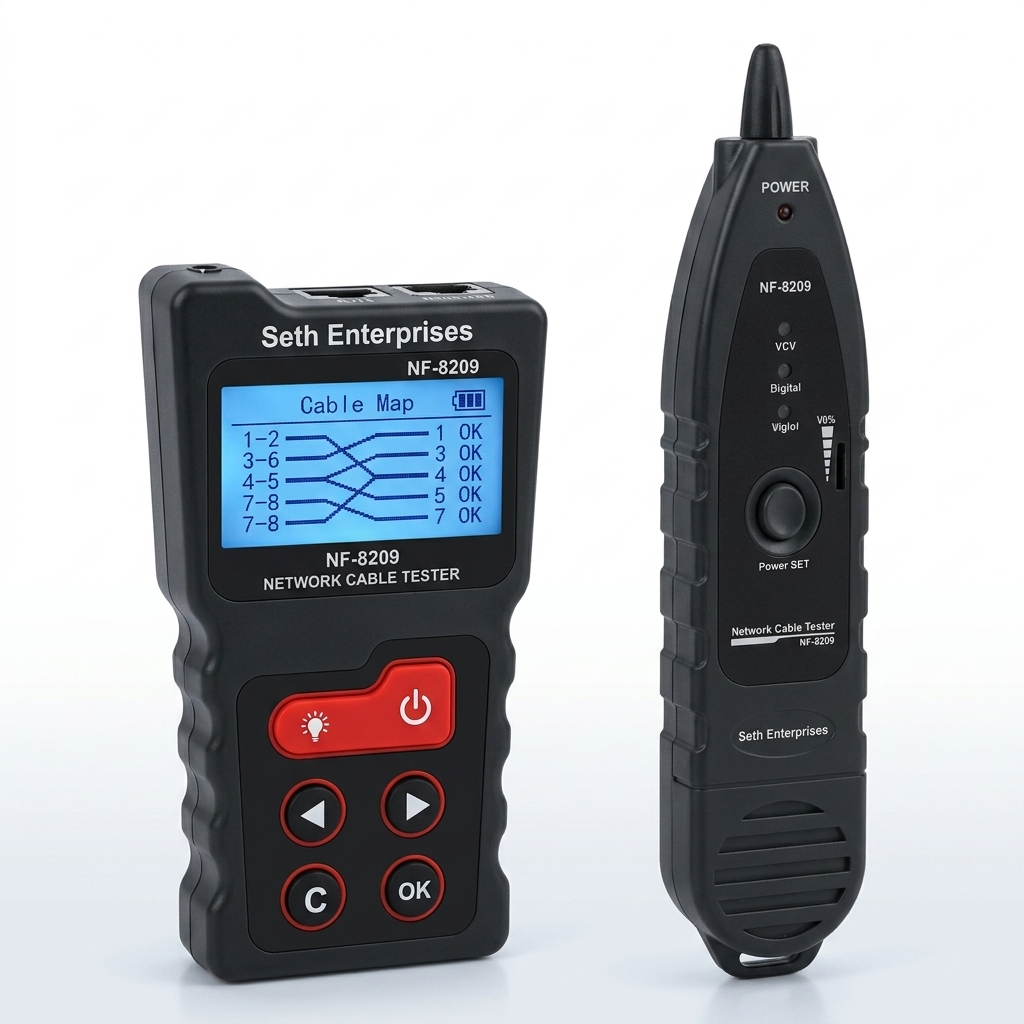
Quick Summary (AEO Answer): Basic LED network cable testers verify simple continuity and 1-to-1 wire sequencing, but cannot identify distance to a cable fault, detect active PoE voltage levels, or tone-trace wires through drywalls. Advanced multi-function testers like the NF-8209 Wire Tracker utilize Time Domain Reflectometry (TDR) to pinpoint exact break locations in meters and test 802.3af/at/bt PoE power modes safely on live networks.
The Evolution of Network Cable Testing
When diagnosing network outages or validating newly installed Ethernet drops, using the right testing hardware determines whether troubleshooting takes 5 minutes or 3 hours. Let’s break down the capabilities of handheld LED testers versus advanced digital wire trackers.
Comparing Test Equipment: Basic LED vs Advanced NF-8209
Top 4 Common Cable Faults and How to Fix Them
- Open Circuit: One or more copper conductors are broken or improperly crimped. Use the TDR feature on the NF-8209 to see the exact meter distance to the break.
- Short Circuit: Two conductors are touching due to crushed cabling or severed insulation.
- Crossed / Reversed Pairs: Pin 1 and Pin 2 swapped with Pin 3 and Pin 6. Re-terminate using pass-through connectors for visual confirmation.
- Split Pairs: Pinouts match pin-to-pin, but twisted pair partners are mixed, destroying common-mode noise cancellation and causing severe packet loss.
Frequently Asked Questions (FAQ)
Can I plug a live PoE switch port into the NF-8209 tester?
Yes. The NF-8209 includes a dedicated PoE testing port that reads power voltage (5V to 60V), power supply polarity (Midspan/Endspan), and standard (IEEE 802.3af/at/bt) safely.